Redington Middle East and Africa is a leading IT services and solutions provider, founded in 1999, with its headquarters in Dubai, UAE. The company specializes in technology distribution, value-added services, IT support, and logistics solutions. Redington serves as a vital link between leading technology brands and markets across the Middle East and Africa. The company boasts an extensive network, delivering products and services to over 38 emerging markets and representing more than 290 international brands in the IT and mobility sectors.
With a strong focus on eliminating technology friction, Redington leverages its robust platform to ensure seamless technology adoption. The company’s core values—uncompromising integrity, respect and trust, teamwork, customer-centricity, and a strive for excellence—guide its mission to bridge the gap between technological innovation and its practical application.
Why We Are Partnering with Redington Middle East and Africa
Our collaboration with Redington Middle East and Africa marks a significant milestone in our journey towards driving sustainable and innovative financial solutions across the continent. Redington’s extensive experience in technology distribution and their strategic presence in the Middle East and Africa aligns perfectly with our vision of integrating ESG principles into financial systems.
Key Benefits of Our Partnership:
Expanded Reach: Leveraging Redington’s vast network allows us to extend our services to a broader audience, ensuring that more financial institutions can benefit from our ESG-focused solutions.
Technological Expertise: Redington’s expertise in advanced technology platforms and value-added services enhances our ability to deliver cutting-edge financial solutions efficiently and securely.
Sustainable Growth: Together, we are committed to fostering sustainable development by integrating environmentally friendly practices and social responsibility into our business models.
We are excited about the synergies this partnership will bring and are confident that, with Redington, we will drive significant positive change across the African financial ecosystem. To learn more about Redington Middle East and Africa and explore their offerings, visit their website (Redington Group) (SignalHire) (SAS).
At Sustainical, we are excited to partner with BlueSPACE Africa, a leading fintech company based in Ghana, dedicated to transforming the African financial ecosystem through innovative and sustainable solutions.
About BlueSPACE Africa
BlueSPACE Africa specializes in building financial backbone systems and infrastructure that ensure secure and efficient transactions, positively impacting individuals and organizations across Africa. Their proven track record of resilience and extensive global partnerships allow them to leverage enterprise-class software and advanced technology platforms to deliver cutting-edge financial solutions.
Key Areas of Focus
🔹 Financial Cloud Solutions: BlueSPACE offers a Fintech as a Service (FaaS) model, enabling financial institutions to seamlessly integrate ready-to-use fintech solutions. 🔹 Trade Finance Automation: Their BlueTRADE platform revolutionizes trade finance by automating and expediting trade processes. 🔹 Strategic Partnerships: Collaborating with both global and local partners to provide comprehensive fintech services, including digital infrastructure, cybersecurity, and AI solutions. 🔹 Innovation Hub: Supporting digital transformation for startups and established businesses, fostering the adoption of emerging technologies.
Together, we aim to drive a deeper conversation across central banks, commercial banks, and stock exchanges in Africa, integrating ESG principles into financial systems for a sustainable and inclusive financial future.
Learn more about our partnership and BlueSPACE Africa’s impact on the financial ecosystem by visiting their LinkedIn page.
Introducing WITS Global: Your Partner in Cutting-Edge Telecommunications and Beyond
We are excited to partner with WITS Global, a pioneering company in providing comprehensive solutions across telecommunications, media broadcasting, civil & electro-mechanical services, and enterprise solutions. Established in 1988, WITS Global has a proven track record of delivering high-quality services and innovative solutions that cater to the evolving market needs. Their expertise spans across various domains, ensuring that their clients receive tailored and effective solutions.
Key Services:
Telecommunications
Media Broadcasting
Civil & Electro-Mechanical Services
Enterprise Solutions
Renewable Energy
Home Automation
WITS Global’s commitment to excellence and innovation makes them a valuable partner in driving sustainable progress and digital transformation.
Introducing Exuvi8: Your Partner in Sustainable Data Centre Solutions
We are thrilled to partner with Exuvi8, a leader in designing high-performance, energy-efficient Edge facilities that prioritize environmental sustainability. Established in 2020, Exuvi8 aims to revolutionize the image of data centres by reducing their physical, energy, and carbon footprints without compromising performance.
Key Services:
Power and Cooling Solutions
Feasibility Studies
Data Centre Architecture
IT and Software Services
Managed Services
Exuvi8 collaborates with top industry partners to deliver innovative and bespoke solutions that meet global energy and climate goals.
The article explores the distinction between ‘momentum’ and ‘motion’ in the context of organizational change and sustainability within the tech industry. It emphasizes the importance of meaningful progress over mere activity, using the analogy of motion versus momentum to inspire a deeper commitment to sustainable and impactful actions. By Friederike Zelke, initially published by The Cloud Report.
Foundation for carbon neutral sustainability – LF Energy
This year I attended the LF Energy Spring Summit. While I was searching for open source, sustainability, energy awareness I found LF Energy, a sub-foundation of Linux Foundation that is focused on the power systems sector. I don’t need to introduce the Linux Foundation, but maybe not everybody knows LF Energy: “LF Energy brings together stakeholders to solve the complex, interconnected problems associated with the decarbonization of energy by using resilient, secure and flexible open-source software. Digitalization facilitates a radically energy-efficient future. When every electron counts, renewable and distributed energy provides humanity with the tools to address climate change by decarbonizing the grid, powering the transition to e-mobility, and supporting the urbanization of world populations.”
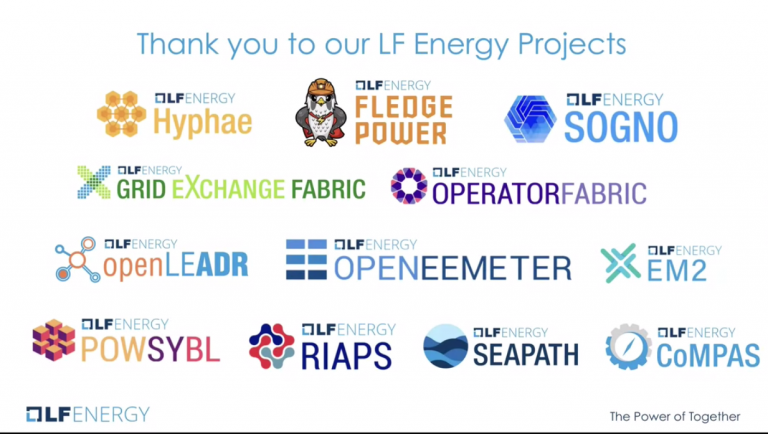
Fig. 1: In LF Energy several projects are gathered with the aim to achieve 100% decarbonization with sustainable open source technology.
I´m quite happy to live in Europe where topics like climate change, energy awareness, natural and mineral resources, future quality of life, are in a broader consciousness of governments and people. The European Union has signed the Green Deal and all countries make their own climate policies. And those forces organizations, companies, and enterprises to make the change as well, which gains recently in the signing of the Climate Neutral Data Centre Pact by several European IT providers.
But climate and energy are global concerns. The European approach is a great start, but we need to work on the goal that energy efficiency, carbon free energy, renewable power and sustainable energy infrastructure become the better options for all countries. Digitization is an important step towards this direction. But in most cases digital innovation and the change to digital infrastructure are expensive and accompanied by many fears – as changes always are.
But we need to talk about all the great opportunities and ideas which already exist. We need to use all possibilities to work jointly and collaboratively, to open source our code, to push forward digitization, and find new, sustainable, forward-looking, carbon free energy, and technical solutions. I love the fact that the great, global Linux Foundation thinks the same and took LF Energy under its roof!
After the summit I wanted to know more about the LF Energy, and I had the great pleasure to meet Shuli Goodman, founder and executive director of LF Energy:
Please tell me about you and the LF Energy. How long are you part of The Linux Foundation, and what are you doing and why?
Just over four years ago, right after Trump was elected, I recognize that there was a tremendous opportunity, with regards to open source and building the common non-differentiating kind of infrastructure that is going to support the energy transition. And I went to The Linux Foundation, and I said I was looking for “Switzerland”.
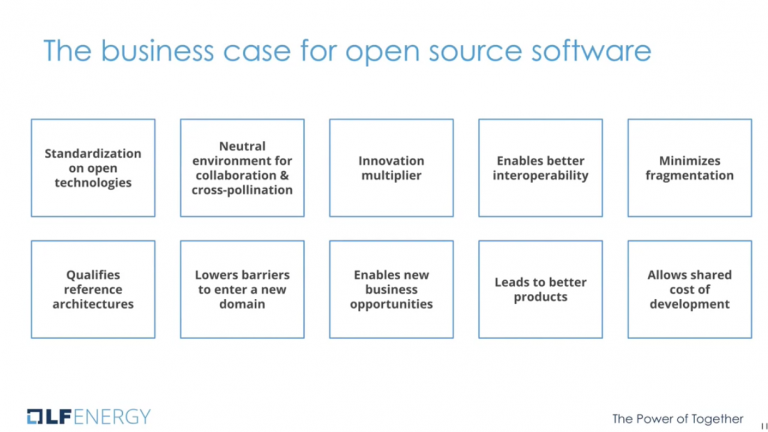
They joked and said that’s often-what people want. What I meant was that I wanted some place that was neutral, where we could put our code, and build the non-competing software plumbing that will power the energy systems of the future. I think at the heart of The Linux Foundation brand is the notion of precompetitive cooperation and precompetitive collaboration, being able to build the digital pipes that connect things that allow people to build on top of it. And I thought it was such an obvious idea that everybody was just going to go, yes, and then boom, it was just going to become like a big garden. But instead, I realized that it’s a very big project and that it has required a considerable amount of socializing the ideas about what is the benefit of open source, what’s the business case (fig. 2).
I began by looking for unicorns. All the early innovation is in Europe. And so, RTE and Alliander were the first unicorns and then TenneT and Energinet. It is through engagement of network operators and end-users that we can begin to define the common parts. The next challenge is how were we going to build this out and then sharing and communicating that message to the world.
I think that it’s going well, it’s slower than I imagined. But I am a gardener, and so I believe that if you keep tending you’ll succeed. Who’s to say how big this garden needs to be and so it’s just taking time, it’s a little bit before the market is how we would describe it. But I see now that there’s momentum that’s coming, and there is a convergence of things that is occurring, that is really central to our mission which is a kind of the intersection.
When I think of the building blocks of the power system network for the future, you have 5G and a kind of communication pipes that are going to allow for really a kind of instantaneous microsecond, millisecond of transactions. And then you’re going to have edge and distributed computing and cloud native. Which really is at the heart, because you can’t have a distributed energy without talking about distributed computing.
When I think about how to make the transition, I think at the core is economic. My background is innovation that’s what my PhD is about and so I take an economic definition of innovation, which is the ability to do more with less, and so I believe, if we can do more with less resources we will win this, and so my job is to create a kind of the commodity software that enables commodity hardware that enables the entire planet to become electrified and that’s how we think about it.
Fig. 2
Could you please summarize the goals of the LF Energy and why we should think this globally?
Well, our goal is 100% decarbonization. 75% of decarbonization need to come from our power system networks, transportation and the built environment. Our power system networks lead. Because you have to transform the power system networks by being able to manage massive quantities of data and then be able to choreograph and orchestrate that in order to manage and maintain grid stability. And to onboard increasing levels of renewables and intermittent low inertia energy.
So, we’re an open source foundation, we live inside of The Linux Foundation, our sister foundations are CNCF, LF Networking, LF Edge, Hyperledger, Automotive Grade Linux. All of these represent the core parts of the energy transition, and so it makes sense that you would put the foundation in The Linux Foundation.
I think another reason why we did that is because all of us have the experience of how challenging and difficult it is to work together with many different stakeholders and to be able to achieve outcomes. And one of the things that The Linux Foundation has demonstrated over and over and over again, is the ability to create environments. Where people actually can work together and collaborate and get things done.
I joke and say you know the Linux Kernel, the Linux operating system started in a dorm room in Finland and 30 years later, is the really the foundational operation system for the planet and there were no politicians involved, nobody got killed, there were no standing armies. It became foundational and the way that it happened was developer to developer to developer. People basically said, this is a project, I want to participate. And there’s a sense of agency that people have and a do-ocracy that if you’re good at what you do, you can participate and that it’s an ecosystem.
I look at it like a gardener which is, if you create the conditions, the thing will grow and so that’s what I’m doing. I’m building it on top of the intellectual property and the legal framework of The Linux Foundation. At the heart is the Linux Foundation DNA and the history of how all this software has gone from the edges to central in such a short time. Aside from the Kernel there’s also LF Networking where 70% of all mobile traffic goes over open source, Automotive Grade Linux: 60% of all automobile ship are sailing with AGL inside.
How can open source help to achieve carbon free energy on the planet?
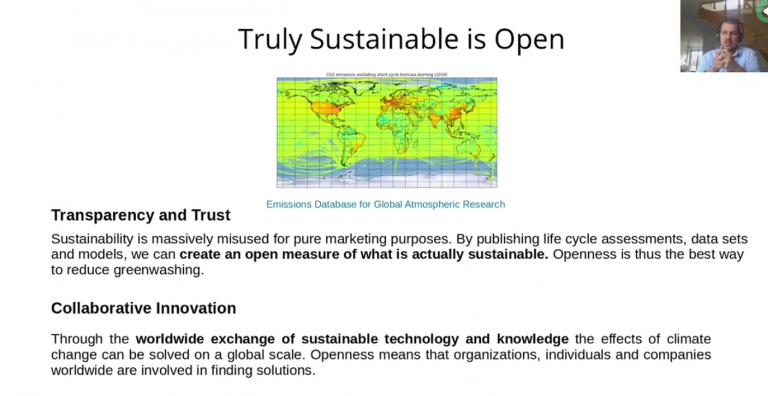
Digitalization is what we do to build communication pathways between hardware and either controller orchestration or choreography software. We want to create the conditions for massive innovation and if there is only proprietary communication software, that creates vendor lock-in. We want interoperability, so that it we can drive scale and plug and play (fig. 3).
Fig. 3: Slide from Tobias Augspurger´s talk at LF Energy Spring Summit, founder of the open source project Protontypes
For instance, when we first started the internet, we imagined certain things would happen that there was going to be a convergence of open source, there was going to be a convergence of telecommunications, media, computing. We didn’t imagine that we were going to have unlimited music, we were going to be able to completely document every single thing that ever happened in our lives, nor were we going to have access to shopping, research, and so on. We just never imagined it was going to be so transformative, but the reason why that happened was because, at the foundational level, the internet is built on standards and open source, and that open source enabled very rapid iteration and kind of mechanisms for innovation. And we want to do the same thing around energy and the energy transition.
As an example, AT&T believed in the transition from a kind of network operations and telecommunications, which was very hardware centric, that they were moving to 75% digitalization. And that’s probably a little hard for energy to imagine that we’re moving to 75% virtualization, because electrons need a physical path, a physical service in order to move, you can’t throw electrons through the air. So, we’re probably not going to get 75% virtualization, but I would imagine that perhaps we could go to a 50% software defined infrastructure which is not only about cost, it’s about time and resources.
But the reason why you do it is to create what I would refer to as radical energy efficiency so that every electron counts. Right now, we flick a switch and open the pipe up and just throw a lot of electrons at things. We want to become much more precise about how electrons flow. That requires digitalization, that requires metadata about the electron to choreograph it, orchestrate it, forecast it, plan it, understand the analytics of it.
To build markets that use price-based grid coordination, is a simple idea that uses price signal to communicate to the devices in our homes, businesses, and industry in order to drive behavior and usage based on availability and demand. To all the things that draw energy or create energy that this is the role they should be playing right now. We need flexibility to send signals to back off of our heat or our cooling or power down a refrigerator or don’t do the laundry right now, because we lack capacity. That’s actually a quite simple and elegant idea. It is difficult to execute though!
In some ways we will be creating what real live currency markets driven by electrons. That’s the direction that I think we’re going in and that open source is at the heart of it and digitalization is critical.
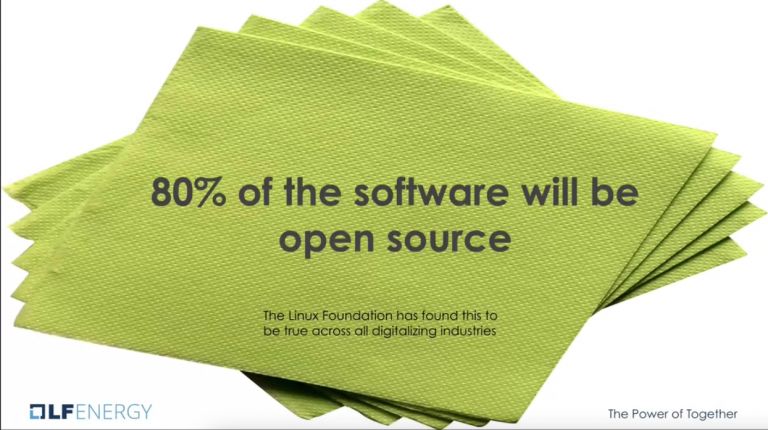
Just one more point, which is that we have found that in a more mature industry 80% of software will be open source and 20% is proprietary and built on top of all those open source parts. That’s really the rubric that we’re using so if 50% of the energy transition is digital and being able to coordinate and orchestrate hardware and then 80% of that software is going to be open source which would then suggest that 40% of the energy transition is open source and is figuring out how to bring all these pieces together to enable these markets that this opportunity, the energy transition to emerge. That that’s how I do the math (fig. 4).
Fig. 4
Here in Europe we try to be aware of energy efficiency or carbon neutral energy, we have the Green Deal from the European Commission and the Climate Neutral Datacenter Pact from different cloud providers and so on. How can we spread the word to the world? Could you advise Europe to do more, to become a role model for the other continents?
My experience is that, right now, Europe is leading the world by making a declaration of commitment to decarbonization. I think that Europe has gone all-in recognizing that there is an economic transformation that’s going to take place and that can drive the transformation. This is policy and policies at best drive markets where actors like utilities receive those signals and begin to transform. Even if it seems frustrating or that it’s happening slowly, there is momentum and there is motion. We have to trust that momentum and put all our energy behind that momentum.
But you know it’s also to continue to create the conditions for those transformations to take place to get to 50% or 60% decarbonization in the next decade. I’m not saying it will be easy, but I think that it will be relatively easy compared to what it’s going to take for the second 50%. Looking back, these will be the easy years.
The remaining parts are going to become increasingly complex and are going to require increasing levels of cooperation amongst humans about what we do and what we’re willing to say we won’t do, so that becomes a social project. It really is going to require everybody to participate in those transformations.
The United States has been a very confused actor in this space. Our oil and gas industry had begun winding down and then fracking was developed and the US became one of the top three oil producing countries again. This created some powerful special interests and strange bedfellows. The US is not alone. Russia has very entrenched views. Without a diversified economy, Russia wants Europe to continue to buy its products because it has no other mechanisms for generating wealth. The odd vortex of the Trump years was the US working to collude with Russia to ensure slowing the energy transition down.
What we are trying to do with decarbonization is unbelievably complicated. In the US there are people who’ve been elected, right now, who have sobriety in terms of seeing what’s in front of us, but you have utilities and states that are in varying degrees of agreement about what to do. For instance, I recently was reading something about how Wyoming was going to sue state that won’t buy their coal anymore to bully us into buying their coal. So, there’s going to be a lot of that in the next 10 years.
In closing, one of the most important parts of LF Energy – and again I’m a gardener – I believe that you don’t plant the garden of the future in the garden of the past. There needs to be enough containment of the garden to protect the future as its emerging. I’m pretty confident from everything I know that the dominant paradigm will try and reassert itself and control the outcome. Partly I feel like LF Energy is in The Linux Foundation, because The Linux Foundation will protect it. And I will protect LF Energy.
Thank you and I´m very touched, because the environment, sustainability and the future are my heart topics. We need this transformation to gain future for our kids and the next generations.
Exactly. We really want the digital infrastructure companies to get involved with LF. We’re really in the beginning, there’s a leap of confidence that people have to make to say – “let’s do this work together, let’s work together inside of a community like LF Energy”. I trust that we will be able to be successful. It’s like a gathering of the tribe. There’s a very limited set of people who are going to do this, I mean everybody is going to get in get involved, because our lives are going to change, but from a technical perspective it’s a relatively small set of people.
We have to come together and just say “okay let’s do this here, this will protect our intellectual property, and this will help us get there”. Anything that you can do to get that message out, I would really appreciate.
This article outlines the Climate Neutral Data Centre Pact, where 73 companies commit to making data centres in Europe climate neutral by 2030. This initiative, aligned with the European Green Deal, focuses on improving energy efficiency, using clean energy, and implementing sustainable practices to minimize environmental impact. by Friederike Zelke, initially published by The Cloud Report.
Cloud computing and digitization are important parts to fulfil the European Green Deal, therefor several cloud service provider signed the Climate Neutral Data Centre Pact. Here you find a short description what this means.
That the climate is changing we know for decades, but during the last years we all experience what that means. We cannot stop the change, but maybe we can mitigate it and learn how to deal with the consequences. The biggest cause is carbon emission. So, the biggest goal must be to stop carbon emissions, the best to shut it down to zero. We all live in a complex environment, and we cannot influence everything, but we can begin in our sphere of action. This have 73 companies of cloud industry done last year, they signed the Climate Neutral Data Centre Pact. They took the challenge of the “Green Deal”, a set of green policies initiated by the European Commission, seriously and resolved to become climate neutral till 2030.
Beginning in 2020, CISPE engaged with the European Commission in a series of workshops. The aim was to discuss a common approach and define what “climate neutrality” means for cloud infrastructure services. It was especially important to define clear and measurable goals for 2030, including clear milestones in 2025 to ensure rapid progress for the industry. It was also important to make it accessible to European SMEs, without burdening them too much.
It was also important to cover the data centre industry at large, including, for example, delivery models like colocation. CISPE joined forces with EUDCA (European Data Centre Association) to develop the agreement and cover all industry players. Many other trade associations and industry players across Europe joined the pact; including Germany (Eco), France (EuroCloud France, France Datacentre), Netherlands (Dutch Hosting Provider Association, ISPconnect, Dutch Data Centre Association), Denmark (Danish Cloud Community), and Poland (Cloud28+, TechUK).
5 promises to carbon free data centres
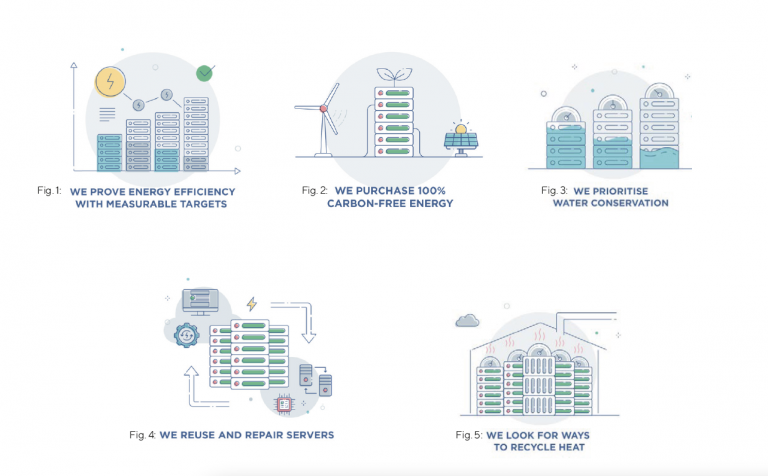
The pact serves 5 objectives: energy efficiency (using less power to deliver the same data compute and storage), carbon free power, water efficiency (using less water for cooling of the same workloads), recycling and reuse of heat produced by datacentres.
The metrics defined may lead to operators having to adapt the design of datacentres by 2025, and having to retrofit existing ones by 2030. It will also ensure that power used will be 100% carbon free by 2030 (75% minimum in 2025), and ensure the reuse, repair or recycle of all server equipment:
Energy Efficiency
Data centres and server rooms in Europe shall meet a high standard for energy efficiency, which will be demonstrated through aggressive power use effectiveness (PUE) targets (fig. 1)
Clean Energy.
Data centers will match their electricity supply through the purchase of clean energy (fig. 2).
Water
Data centres will conserve water and set ambitious water conservation targets (fig. 3).
Circular Economy
The reuse, repair and recycling of servers, electrical equipment and other related electrical components is a priority for data centre operators (fig. 4).
Circular Energy System
The reuse of data centre heat presents an opportunity for energy conservation that can fit specific circumstances. Data centre operators will explore possibilities to interconnect with district heating systems and other users of heat to determine if opportunities to feed captured heat from new data centres into nearby systems are practical, environmentally sound and cost effective (fig. 5). A big step was taken, the European Commission took the governance of the pact and will ensure the fulfilment of the promises.
Customers of cloud services now have the possibility to choose their provider not only for their services but also for their sustainability. The faster this becomes standard the better for all of us.
by Friederike Zelke, initially published by The Cloud Report. This article celebrates the value of open infrastructure, spotlighting the significant contributions of open-source communities to technology and society, especially during challenging times. It highlights the communal ethos of organizations like CNCF and OIF, underscoring the importance of collaboration, diversity, and inclusion in driving innovation and sustainable development within the tech industry.
The last year has influenced many things, and we have noticed it most in our professional lives in the way we work together. We are now used to communicating and working via a screen and sharing resources. But for a large part of the IT world, this was not new – the open source communities.
But it wasn’t just the way of collaboration and interaction that brought open source even closer to us. In fact, it’s more a different aspect. In spring of last year, we were all more or less overwhelmed by the situation, but instead of thinking in solidarity and looking for common solutions, most people acted exclusively selfishly, racking up what they could and fighting over toilet paper and about wearing masks.
Here in Germany, we live in an affluent society; no one was in any way threatened existentially, except for those who actually contracted Corona, who at that time were still very few. The call for public spirit arose relatively quickly, for reasonable action and mutual consideration, but this was only heard over time. This reaction showed everyone that people seem to be more inclined to build walls, to shut themselves off, to protect themselves than to act together.
Two of the largest open source foundations, CloudNative Computing Foundation (CNCF) and the Open Infrastructure Foundation (OIF), set an example against egoism and boundaries at their events last year.
Diversity
Digitization and the expansion of cloud services were in focus everywhere last year in order to be able to work and communicate at all. In the open source communities, this kind of collaboration and communication has been established for a long time; there are platforms where data, developments and open questions are collected, and forums where discussions, learning and development take place.
The big challenges of the last year were not for open source experienced engineers, the tools and the way to work with them were not new. But it is much more important that behind the handling of the digital possibilities in the open source communities there is a real mindset that is so much in contrast to the behaviour of most in the last year: The CNCF and also the OIF and all other open source communities and foundations stand for openness, for focusing on ideas, for transparency, for real collaboration, for creating solutions together, for sharing resources openly, for respecting each other´s ideas and experiences. This shows they also stand for true sustainability, not only the preservation of natural resources, but also the use of human resources.
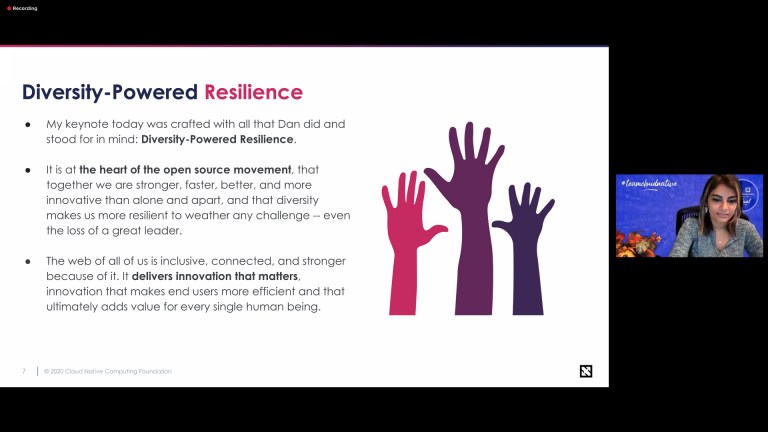
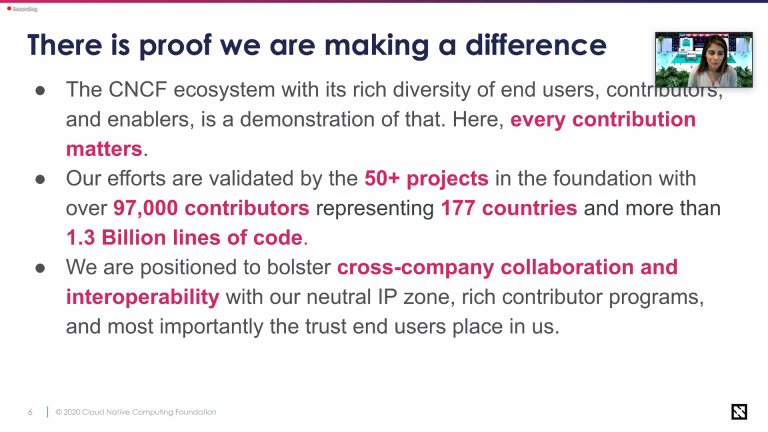
The CNCF has made diversity its main theme, the strength of open source, of community (fig. 1 and 2). With the CNCF’s choice of “diversity” they bring all these points together: the community is made up of a lot of individuals from all over the world (over 103,000 contributors representing 177 countries after five years of Foundation work). They bring in their ideas, experiences, questions and solution strategies, contribute, drive other ideas forward, so that the sum becomes greater than the individual parts.
It is very good and so important to be aware that each contributing individual is valuable! Every idea and question advance the community, no matter who they come from. As part of the community, it does not matter in a positive sense where a person comes from, what gender he or she (or ?) feels they belong to, or what their appearance is like.
The only things that matter are ideas, experience, passion for the content and openness to new solutions. And it was important to me that I am not alone in my desire for such a community. Priyanka Sharma, general manager of the CNCF, summed it up accordingly in her KubeCon keynote: This diversity is also at the heart of the open source movement. Together we are stronger, faster, better, and more innovative than alone and apart, and that diversity makes us more resilient to weather any challenge.
Leaving aside the social aspect of the community for a moment, she is also right on another level: on the whole, open source development is faster, of better quality, more innovative and sustainable in the long term. Without the preparatory work of the open source communities, every developer would have to start over again and again and could only fall back on his own experience, which means that many solutions would not even be available to him/her/? The many-eyes principle ensures that the code is cleaner and better documented, and above all it is more secure, because possible vulnerabilities are noticed much more quickly and can be fixed.
Open!
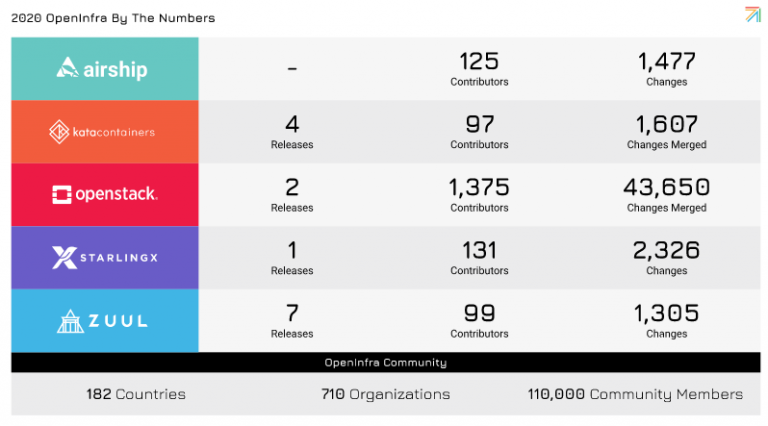
But back to what actually concerns me. After the CNCF already focused on the community at the KubeCons, the OIF also focused on it at its Summit. There, of course, the focus was on the founding of the OIF, which is a logical extension of the OpenStack Foundation. The OIF is a community of projects and companies for the provision and further development of open source infrastructure software, with 110,000 members and contributors from 182 different countries (fig. 3).2
The desire of this foundation is to provide a foundation for cloud-enabled infrastructure. Mark Collier, COO of the OIF, said at the Open Infrastructure Summit that anyone with access to the internet and a computer should be able to participate in two ways, firstly as a contributor and secondly, of course, as a user of the programs that are available as open source. This clearly also has a social aspect. The hurdle to participate in open infrastructure is very low and everyone is welcome. But anyone can also use the applications provided by open source and build up a business with them.
Anyone with a good idea has the opportunity to implement it without having to buy expensive software licenses or become dependent on a provider. Thus, open source also offers a kind of freedom and design possibilities.
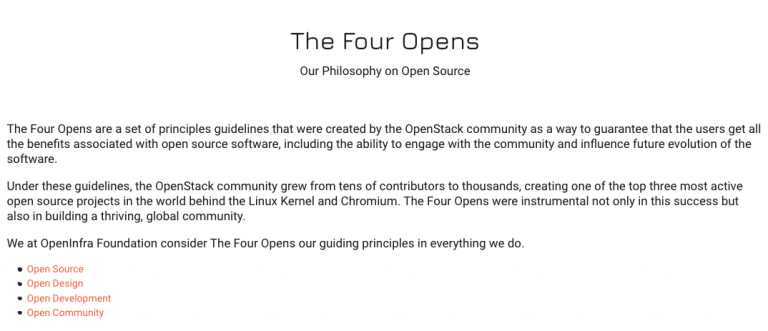
The OIF has also formulated its principles and presented them at the Summit: the four opens (fig. 4).3 They make it just as clear what they stand for and how they work together: open, technology-oriented, impartially, global, inviting – thinking borderless.
Both of these great foundations have spoken from my heart. The open source communities show how progress in the world should look like, how it can work in a sustainable and engaging way, but above all what real togetherness can achieve, what community without prejudice, but cooperation can bring in ideas for great results. Cooperate with openness and respect. A lot of people can take a leaf out of this approach.
We are, of course, members of both foundations because we work and contribute in a cloud-native, open source way. We were happy to become a member of the newly founded OIF, because we love open infrastructure!
by Friederike Zelke, initially published by The Cloud Report. The article examines the link between open-source software and sustainability, illustrating how open-source practices support environmental goals through innovation and collaboration. It argues for the broader, beneficial impacts of open-source beyond just cost-efficiency.
– does it compute?
When thinking about open source and sustainability, one of the first things that comes to mind is that they are currently very much Zeitgeist. But what about them in combination? Does it make sense to use them as a pair? And is there perhaps a wider correlation between them, apart from software and infrastructure? Let’s find out…
Sustainability in software and infrastructure is often understood as lowering costs, since – obviously – spending less money is more sustainable than spending more of it. With this in mind open source software appears to be a perfect enabler for a more sustainable approach, since it is considered to be free. Or is it?
Is open source free?
Don’t be fooled: open source is not free per se. The term “open source” refers to the fact, that the source code of a given project (and most often, only a part of it), is made available to the public for review and auditing purposes.
This does not imply the software being free to use, or a potential user being allowed to modify and use the software freely. As an example: Microsoft is amongst the biggest contributors to open source software, and quite heavily uses it in its products. But Microsoft’s products are not free, and neither is it permitted to freely modify and use their software.
It all depends on the business model, and the license being granted by the author.
Open source vs. crippled source
Since it is true that most software being published as open source is given a relatively open and permissive license, such as Apache 2.0 license, many if not most of the software is nonetheless not usable per se, since most of the licenses do not demand the software as a whole – including installation scripts, additional components, and internal tools – to be made available.
This quite often leads to situations where a potential user of a software would not be able to use it at all, since important components or aspects of given software would be missing or would only be made available to paying customers under special licensing.
This habit of leaving out important aspects of an open sourced product is called “open core” model, and is very often utilized by larger software vendors, such as Red Hat or SUSE, since it allows them to position themselves as “open source vendors” without actually being that open.
Access to products is very often granted based on yearly fees. One is only allowed to install time or feature limited trial-versions of a product, while a continuous usage would imply either buying a license or signing up for a so-called support subscription. While it is true that such software is often made available as community editions, again, these editions are mostly feature limited.
This can only lead to one conclusion: open source does not necessarily imply a cost-saving approach. Or, to put it differently, open source is not per se sustainable.
Bringing sustainability to open source
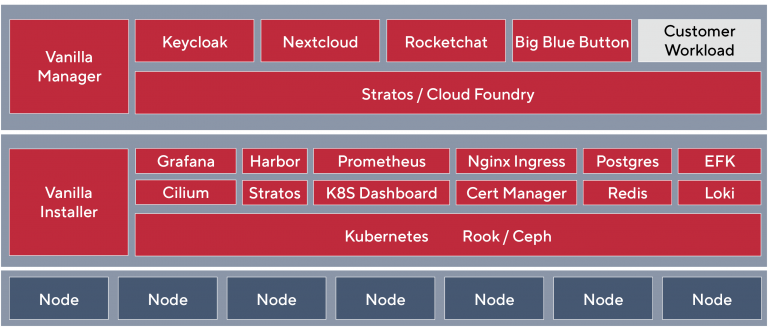
To achieve sustainability with an open source approach, only software being completely published under a permissive license (Apache 2.0 or similar), and not being made available as open core solution, should be considered. This, in fact, leaves out most of the larger and / or commercially oriented software vendors, but it is crucial for financial and business sustainability. One of the projects being completely built upon these principles is VanillaStack, a Kubernetes distribution which is provided with everything one needs to set up and run a Kubernetes cluster on literally any platform, with the idea of taking away complexity and vendor lock.
Fig. 1: a complete open source stack to set up and run a Kubernetes cluster
Financial sustainability
Financial sustainability is achieved by not having to pay for licensing or enforced subscription costs. Financially sustainable software does not cost anything and is available without limitations. The business model of organizations going that route depends on providing commercial support and / or additional services, such as managed services or hosting services. When software does not imply a cost-factor per se, but is maintained by a vendor, it can be considered to be financially sustainable from a user’s perspective. Obviously, money needs to be spent for support and or additional services, allowing the vendor to continue its operations.
Business sustainability
Business sustainability is achieved by open source only when it is – again – not just some sort of an open cored model. A complete open sourced product allows to achieve several business-critical aspects:
More security, since the whole code is available for audits and security inspections
Less vendor lock, since the whole product is available to the user, not some form of locked-down base version
More knowledge for teams working with the product, since everything is laid out to them
Lower costs of ownership, since the product is typically used by more customers, which creates bigger audience and community
These factors all contribute to business sustainability, allowing customers to work over a longer period of time deeper and more reliably with their software stacks. As a result, true open source is way more sustainable then using crippled open source or proprietary solutions.
Sustainability and open source on a more fundamental level
Open source is very often driven by communities of passionate people. Many of them start projects and work on them in their spare time. Therefore, it should be of no surprise, that the ideas of an open source movement have spread far beyond the scope of “just” software or infrastructural solutions: Currently, projects around open sourced processors, computers, printers, vehicles and bikes, medical equipment, and even houses, are in active development or already on the market. All of these projects aim to get rid of proprietary knowledge and target a more sustainable approach to things: With community driven development, with making plans available, with an inclusive approach to participation, they allow for spreading knowledge, for incorporating experiences, and for preventing from built-in and purposefully implemented obsolescence, thus leading to more sustainability and less waste.
Open source and climate change
Since the open source culture is centred around community and collaboration, it should be of no wonder, that open source projects also try to address the issues of climate change and ecological disaster.
Searching for “open source climate change” reveals a long list of open source projects. A good overview of such projects delivers the website Open Sustainable Technology, which groups these projects into categories, provides links and explains their purpose.
Also, large open source foundations, such as The Linux Foundation, are hosting and supporting open source sustainable projects. Take LF Energy, whose goal is to support and provide open source solutions focused on the power systems sector: The projects of this foundation provide a unified approach allowing to utilize a neutrally developed and maintained development environment and toolboxes for this sector. The Cloud Report had a great interview with LF Energy’s founder and executive director Shuli Goodman.
The approach of such projects and foundations is a very sustainable one on its own, since it prevents single player in the markets from having to develop software components and platforms themselves, allowing them to focus on bringing them into production, utilizing them, and gaining knowledge on a faster scale.
This knowledge then can be used to speed up decarbonization, contributing to the ideas of sustainable software, sustainable software ecosystems, and to a more sustainable future overall.
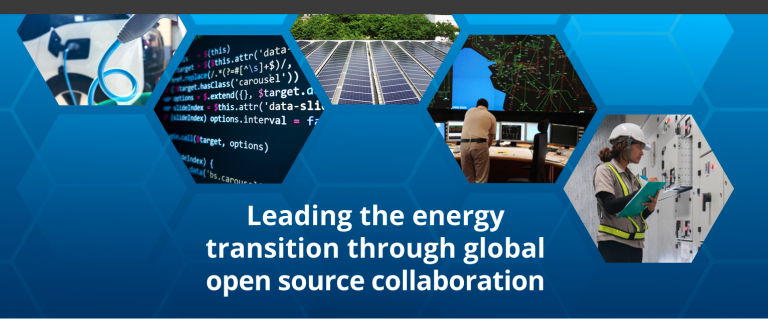
Fig. 2: The LF Energy brings together open source projects with an energy saving and sustainable approach.
Summary
To sum this up: open source and sustainability belong together. On many levels – reaching from avoiding vendor locks, spreading knowledge, having control, ensuring security, preventing from obsolescence, to provide support for fighting climate change. When done right, even commercial aspects and market positions of companies cantered around open source benefit from it.
Both aspects add to each other. The spirit of independently developed and maintained projects, which allow their users to focus on usage and adoption, rather than to reinventing the wheel over and over again, directly leads to more sustainability.
To put it differently: true sustainability in business, in ecology, in infrastructures, can only be achieved with open source, since it enforces sharing of ideas, open discussions and diversity on pretty much all levels.
Therefore: yes, it does compute! And it should be understood as one of the primary models to software and platform development, to infrastructure, and to a more sustainable and inviting future.
The article discusses Green IT and sustainable data strategies, focusing on the importance of climate-neutral IT solutions and the broader social value of sustainability in technology. It highlights the role of open source solutions, transparent processes, and the need for software and hardware to work together for reduced energy consumption. The article also emphasizes the necessity of data maintenance and strategic deletion to support sustainability, and the potential for machine learning to enhance data management for energy efficiency. By Friederike Zelke, initially published by The Cloud Report.
At the it-sa last year in Nuremberg, ownCloud presented its contribution to Green IT and the concept of sustainable data strategy. This article takes a closer look at how they want to support climate-neutral IT in a sustainable way. We at sustainical have the issues of net zero, sustainability, and carbon neutral very much at heart – that is why we are always glad to present successful cases.
Sustainable Data Strategy
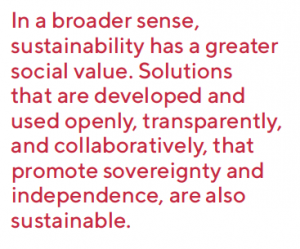
Sustainability can be understood in different ways. In the narrow sense, sustainability means climate neutrality, ecology, green IT, and so on. In a broader sense, however, sustainability has a much greater social value. Solutions that are developed and used openly, transparently, and collaboratively. In software, for example, open source solutions are sustainable. Well-documented open source code prevents the same solutions from having to be developed repeatedly and increases the security and quality of the software, as in most cases the code has been reviewed by several developers. But transparent solutions also offer sustainability and flexibility in terms of processes and hardware solutions. Let us take the example of an ideal data centre that is climate neutral or even generates green energy.
If the basic structure in combination of hardware and software can be communicated openly and transparently, then this solution can be transferred to other data centres. Data centres are always dependent on their specific environment regarding the surrounding climate or waste heat utilization, but transparently communicated experiences and information nevertheless help to build data centres in a climate-positive way at some point.
In addition, if you interpret sustainability more broadly and always look at what opportunities arise from this approach, then a sustainable data strategy requires that organizations use and support open source and that solutions are developed with open standards so that they are able to share this solution sustainably with other organizations as well. This means we do not have to develop the same thing again on their own. This is one of the prerequisites for ultimately achieving a sustainable data strategy.
Sustainability also means that organizations are able to comply with the policies and regulations that they set for themselves as an organization, that are required by legal regulations or that are established in agreement with business partners or customers. This is also part of a sustainable data strategy, which allows you to comply with very different rules, store them transparently for all parties involved and adapt them at any time. This is particularly relevant for organizations in regulatory industries.
Green IT
Sustainability therefore means long-term and ecological solutions, but also openness, transparency, flexibility, being able to work in hybrid environments, or rather to work in whatever environments the user wishes. Green IT should always be sustainable in a broader sense, even if the focus is initially on the ecological side. Green IT is often about the question of the carbon footprint or, for example, about the question: How performant am I with the software when I upload 1000 files? How much electricity do I really consume to do that? Fortunately, this is easily measurable nowadays. This is where the newly introduced ownCloud Infinite Scale (2) solution comes in. Thanks to it, the user is able to upload an amount of small files up to ten times faster. Moreover, higher speed helps saving energy. If I upload faster, if I have to burn fewer CPU cycles to do certain things, I logically save energy at the same time.
Green IT and sustainable data strategy thought together
True carbon neutrality requires close cooperation between data centres and software providers. Much is demanded of hardware providers in terms of carbon footprint, but software developments can and must be energy-efficient in the long term, so that the interaction of software and hardware can result in significantly lower energy consumption. After all, in the long run, providers of digital services will only work sustainably if carbon neutrality is not achieved through climate certificates.
One of the challenges of open source software providers with open standards is that they thus have open offerings that can be operated virtually anywhere. Whether the software is really used in a climate-neutral way always depends on the environment in which it is applied. There are numerous examples of green software, but it is important to use it responsibly, because even with climate-active software you can waste energy if you use it incorrectly or operate it in an energy-inefficient environment. There are some positive examples of open source projects and software, but there are still too few software vendors who think and develop in this direction. The first open source software has been awarded with the Blue Angel. This is the software Okular, a PDF viewer from the KDE Project. This shows that it seems to be possible for software in general to be awarded a Blue Angel. The underlying criteria can become a basis for software development in the long term.
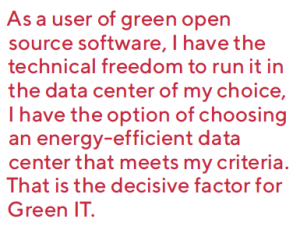
An important step in this direction is definitely to be aware of which partners organizations want to work with and to develop criteria on how the respective organization wants to achieve true carbon neutrality. Many providers claim to be carbon neutral, but only achieve this by buying climate certificates, thus ‘green washing‘. This is where the broader meaning of sustainability comes into play. As a user of green open source software, I have the technical freedom to run it in the data centre of my choice, I am not dependent on a particular provider and, accordingly, not dependent on an environment. I have the option of choosing an energy-efficient data centre that meets my criteria. That is the decisive factor for Green IT.
From 2030, data centres in Europe must operate in a climate-neutral manner. So, such questions will basically also become relevant for data centre operators, especially if it plays a decisive role which software is used or offered. They will have to ask themselves: Which software fits into my climate concept? How can I build my overall environment to save energy sustainably? These questions will not only continue to be important in climate issues, but will also become more relevant in financial terms, as the development of the global energy market will still be tense.
Transparently measurable
In order to achieve the previously described, the overall system must be measurable, and the measurement data must then also be communicated transparently. The total energy consumption is basically measurable, individual applications are only measurable if only this one application is used in a certain period of time. This would also have to be compared with the energy consumption in standby mode. However, in principle, it will be possible to determine the consumption of individual applications: uploading and downloading certain data sets, collaborative editing, and so on. Measurement criteria will have to be developed for this in the future. Standards must be developed on how to implement this so that it becomes comparable.
Data maintenance
A sustainable data strategy means being able to really understand what happens to the data and when, as well as defining exactly when to delete it, for example. Strategic deletion of data then has to do with Green IT in a broader sense; everything that is deleted does not consume any storage space and thus no energy. However, this is a simple connection and only takes effect with a long-term data strategy.
However, control over one’s own data always has something to do with having an overview and keeping it up to date, which means that this cleaning up is often forgotten. However, data has the characteristic that it always becomes more and more and one only rarely deletes things. This can be problematic, as deletion is actually necessary for many regulations. Almost all NDA agreements that deal with confidentiality state that both sides have to delete the data when the business relationship is over. This is rarely checked. And how often the deletion of data really takes place in practice, including the backup tapes, is also a question that arises here. On the other hand, there are retention obligations that have to be complied with. Data maintenance is therefore a challenge for every organization that must be built into every data strategy.
For example, the ownCloud solution is able to set deletion periods. Metadata can be used to define the period of time after which certain files are to be deleted or placed in an archive. For the archives, too, time periods can be defined. For example, if documents have to be kept for 10 years, this can be marked accordingly and they will then be for 10 years. Other archives bring up the files after two years, and if no one has touched the files during this period, they can be deleted. A bit like the “Simplify your Life” method, where once a year you put everything you don’t need in a box. If you realize after a year or two that you haven’t even opened the box, you can most likely just return it to the circular economy, which is more sustainable than throwing it away for things from the household. For data, a different strategy should be used, as they should really be deleted.
Companies should think about data strategy from the very beginning and create a system where employees work in a cloud-based and collaborative data room that is independent of any individual. This means that they do not only have their own data, which is only maintained by one employee and, if necessary, never deleted. However the different workspaces share the data room and then also tidy it up accordingly, and do so together, so that joint archiving strategies can also be developed, which then apply to the entire data room. This also includes a common version management, a common recycle bin for data, a common archiving system and cleansing metadata. This is one approach to a sustainable data strategy.
The metadata can be used to predefine whether something should be deleted straight away or resubmitted after two years. If something has been deleted, however, there is a certain amount of time to find and restore the files. After a defined period of time, it goes into an area where only the support team can restore everything, and again after a defined period of time it is finally deleted.
Currently, ownCloud is working on making data maintenance and processing “smarter” with machine learning. This means that in the future it will be possible to automate much more than today. The system will learn what exactly people frequently touch and what not at all, then report back what has not been used and for how long and, if necessary, make recommendations for archiving. The next future step for ownCloud will be to link this metadata with each other. It will be about linking the various metadata and the various pieces of information that are available and then supporting them in even more intelligent decisions that are not only based on simple policies.
Another aspect of data maintenance is version thinning. When documents are created collaboratively, there are always different versions of the documents that are created, and in most cases not all of them are needed, unless it is something to do with legal documents, where the history of creation would be relevant. Otherwise, if there is a version two, the different variations of version one can be deleted. Implementing version thinning complements active data maintenance in an organization and also supports low energy needs in the long run.
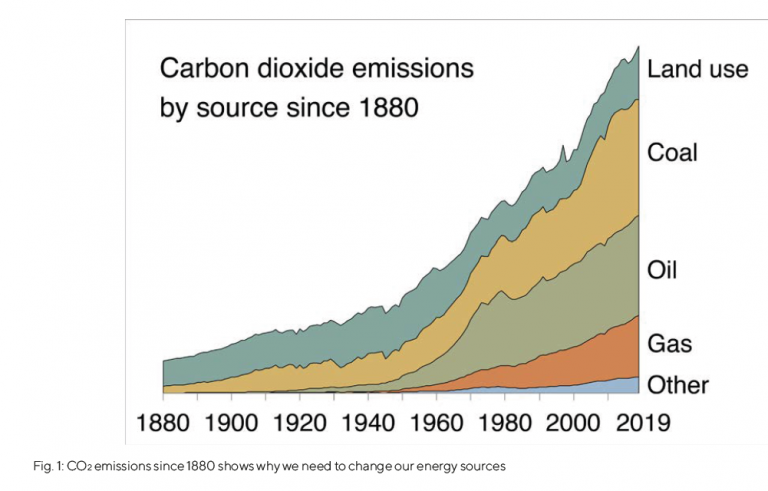
We experience climate change worldwide, and there are no single signs of it, it is everywhere and happening all the time. Carbon plays a big role in the change, around 80% of the produced energy of the world come from fossil fuels, but there are two problems: the plants of this world are no longer able to cope with the amount of carbon, and the resources are getting smaller. We need to stop carbonization!(fig. 1)
Digital processes, technique and approaches helps the reducing, but there need to be more. To talk about what could be done and was done already several experts met at the Net Zero & Sustainability European Data Centre Summit this year. The experts came from three different continents to discuss this global concern and to share experiences and solutions. In focus of the summit was the approach of 100% fossil free energy for data centres and the Climate Neutral Data Centre Pact. Data centres and the connected network need a lot of Net Zero – 100% Decarbonization energy for their digital offerings – scalability, reliability, security, resilience.
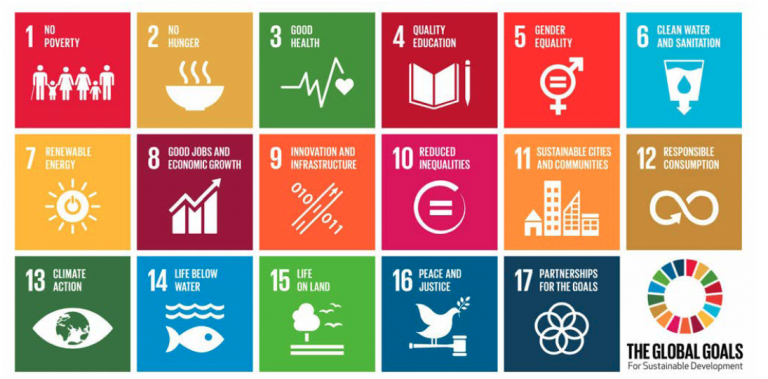
Net zero became a buzzword during the last year, but what does it mean in the area of data centres? Susanna Kass from the UN defined it based on the 17 global goals. Net zero means for data centres that the resources are zero carbon/fossil, the centre emit zero emissions and produce zero waste. Renewable energy needs to be the primary source, therefor clean energy grids are necessary! To gain net zero data centres the whole environment, network, infrastructure, collaborations need to function together. On base of the goals that means you achieve goal 7 (affordable and clean energy) only in combination with goal 9 (industry, innovation and infrastructure), 11 (sustainable cities and communities), 12 (responsible consumption and production), 13 (climate action) and of course 17 (partnerships for the goals,)!(fig. 2)
Important aspects are also the IT infrastructure of data centres with storage, network, energy efficiency, sustainable buildings, grids, usage of materials, and recycling the heat or waste.
The goal should be for data centres to become net zero as soon as possible, but there are many steps to go to aim this goal and some of these steps took a long time. What are these steps? and Do energy policies help? They do, they force all companies on the track, but more important is to be transparent about the consumption, the accounting, and the reporting of it. To make the compliance of the policies of one company visible to all help other companies to collaborate, to follow, and to become compliant, too. Only transparency helps to verify carbon neutrality or sustainable solutions. One issue for data centres is, of course, that they depend on the whole environment: Is enough renewable energy available? Is there a possibility to use the heat?
Another way a lot of companies, not only data centres, are going right now is to buy a compensation to green-wash their statistics, but they are still producing carbon emissions, and there is no proof for the compensation at all! So, the panellists agreed, that this is no viable way to aim the net zero goal.
The whole industry is asked to reduce their emissions and the data centres are leaders in this area, but the change must happen in the society and industry. There need to be a change of mindset as well. The usage of energy must be coordinated with the availability of renewable energy, so the processes and workloads have to be adapted to this. But the customers of data centres expect 24/7 availability and scalability, this will be a challenge during the next years.
But this is meant by changing the mindset in the whole society, also the customers need to change their mind, processes, and usage. And the panellists agreed that governmental policy changes are needed, the motivation for self-regulation of companies and people is in most cases not high enough. But maybe this works only for Europe, but Europe is the place where energy efficiency is forced. First steps are gone with extension of digital infrastructure, but we should not stop here. Net zero needs to become a global goal in the end.
Data centre specific topics were discussed like cooling with water. All these water-cooling technologies are lowering the PUE (Power Use Effectiveness) and allow to use the waste heat. These systems are not very common in data centres but helps with the net zero strategy. Challenge for these systems are the installing costs and the building efforts with water recourses, pipes, and concept for heat usage. Especially for existing data centres. But becoming carbon neutral is something that will require a lot of effort.
The summit happened on Earth day and that fits perfectly. Experts from the whole planet were gathered to share their concerns and ideas. Climate change applies all of us and we need to act. Thanks to the Data Centre World and the Uptime Punks for hosting the panels of excellent speakers, who all transported the serious situation but stayed optimistic.
Manage Cookie Consent
To provide the best experiences, we use technologies like cookies to store and/or access device information. Consenting to these technologies will allow us to process data such as browsing behavior or unique IDs on this site. Not consenting or withdrawing consent, may adversely affect certain features and functions.
Functional
Always active
The technical storage or access is strictly necessary for the legitimate purpose of enabling the use of a specific service explicitly requested by the subscriber or user, or for the sole purpose of carrying out the transmission of a communication over an electronic communications network.
Preferences
The technical storage or access is necessary for the legitimate purpose of storing preferences that are not requested by the subscriber or user.
Statistics
The technical storage or access that is used exclusively for statistical purposes.The technical storage or access that is used exclusively for anonymous statistical purposes. Without a subpoena, voluntary compliance on the part of your Internet Service Provider, or additional records from a third party, information stored or retrieved for this purpose alone cannot usually be used to identify you.
Marketing
The technical storage or access is required to create user profiles to send advertising, or to track the user on a website or across several websites for similar marketing purposes.